Showing posts with label Education. Show all posts

Video Sources

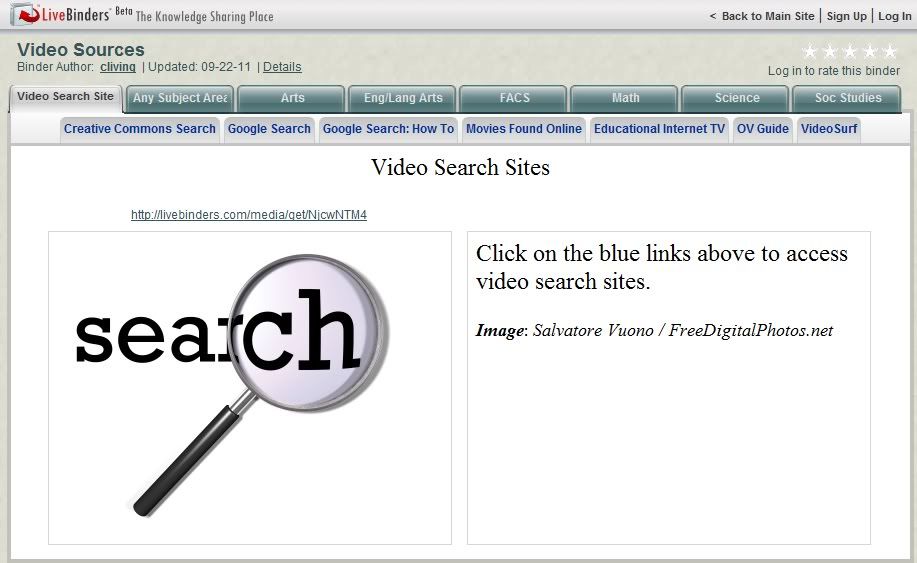
Perhaps some might find useful a LiveBinder of video sources I compiled for a workshop I did earlier this year. 

It includes hundreds of sources categorized by discipline as well as some links for searching. Sites provide FREE videos, though some may also include videos available for a fee.

If you haven't found LiveBinders yet, you might find it useful as well. It's a great way to organize links and to make them available to others. The fact that most (unless the site must be viewed in its own window) will display right on the LiveBinders page can be a benefit in some circumstances as well. It's FREE to use if you wish to create your own binder (public or private), and a search can bring up some great binders which have been created by others.

Read Users' Comments (0)

50 Sites in 60 Minutes

50 Sites in 60 Minutes ver. 2 will introduce you to 50 online tools to use in the classroom or for personal use. Sites included are appropriate for a variety of age levels. Tools are for audio, charts and graphs, digital art, digital storytelling, and several miscellaneous applications. Each slide includes a link to the site as well as a link a review of the site by David Kapular on his blog, Technology Tidbits: Thoughts of a Cyber Hero.

If you're interested in finding new web tools, you may want to follow his blog.

This slideshare presentation is a good example of the great finds I receive in my e-mailbox as a member of Diigo's Web Tools for Educators group. (Read my post on Diigo here.) If you'd like to see what great web tools others find, just create a FREE Diigo bookmarking account and join the Web Tools for Educators group.

Read Users' Comments (0)

EduBlogs Teacher Challenge

Though it may sound like it, Teacher Challenge is NOT a competition or contest--please read on!

There is a wealth of free tools on the web for educational use. With all the time teaching takes, during the school day and on into the evenings, who can keep up with them, let alone learn to use them? Well, here comes Edublogs, known as a great site for hosting educational blogs, with a great idea.

The goal of Teacher Challenge is providing free professional development for educators. The current challenge presents structured tutorials for free online tools...21 of them at the moment. Each one gives directions to get you up and going with the tool along with tips and suggested ways to use it in the classroom. Take a look at #7--Kerpoof for an example.

Interested in blogging for yourself or your students but don't know quite where or how to start? Previous challenges were "Kick Start Your Blogging" and "Blogging with Students." Links to these are along the side of the Teacher Challenge page.

What about PLNs? The power and connectivity of the Internet makes it an amazing time for building PLNs. That's the topic of the next Teacher Challenge, so subscribe to their RSS feed or keep checking back to the site to see when it starts if you're interested.

Read Users' Comments (0)

How to Use Twitter for Social Learning...and more

Do you just not "get" Twitter? I didn't when I first signed up...didn't use it for months. Now I'm following several people and learning so much and finding so many resources and articles and websites. I've learned that people have found all kinds of uses for it in their classrooms and in their professional lives.

What is Twitter, anyway? How do you get started? What do you do? How do you find people to follow? Do you wonder about these things when you think of Twitter? Well, here's a place to start getting answers.

To get you going, why don't you check out Centre for Learning and Performance Technology's FREE How to Use Twitter for Social Learning? You'll get everything from how to get started to how to find people to follow to ways to use it productively. (While you're there, look around. This is a great site.)

If you want more ideas, check out 31 Interesting Ways to Use Twitter in the Classroom (well, it's 31 today, but the count will be increasing!).

Speaking of "Interesting Ways," you might be interested in my earlier post on Tom Barrett's series.


Read Users' Comments (0)

Awesome Screenshot

Do you ever use web page screenshots, either via digital delivery or on paper, to assist in teaching or training? I know I do. I utilize both Windows 7 Snipping Tool and Jing, but I think this tool is going to be one I will use frequently because of its additional features and ease of use.

Awesome Screenshot is an extension currently available for Chrome and Safari, with a Firefox version to be released soon (according to the website).

First, Awesome Screenshot will let you capture the entire page (my other tools don't do that), the visible page, or any part of a page. Once captured, you can crop the image if you wish, More importantly, you can add a variety of markings, including text. This is so much easier than what I've been doing! The image below of part of the Awesome Screenshot webpage I created will give you an idea of what it will allow you to do; the red markings (you can change the color) were my additions.


When you have marked anything you want to mark, you can choose to save the image to your computer; instantly share it via Twitter, Facebook, Google Buzz, Gmail, Yahoo Mail, Hotmail; or get a link to the image for sharing yourself.

Students could use this as well as they find things to share while doing research. Find a good diagram, capture it and annotate it or question it. Find an interesting comment, capture it and mark it up.

Thanks to Richard Byrne, Free Technology for Teachers, for his post sharing this. (Don't follow his blog? You should!).

If you don't use one of the supported browsers and you don't always have access to a Mac or a Windows 7 PC, you might like my post on ScreenRip32.
Read Users' Comments (0)

embedit.in

I've been playing with a web tool called embedit. It's only useful if you have a website, but if you do, I'm sure you can think of some practical uses.

Upload any file* or use a link to an existing website to embedit.in for free.You will get the code to embed the document on your blog or other website, as the Aesop's Fable document below. (Don't know what to do with the code? Many blog or wiki hosts give the option of viewing/editing the HTML of your page Do all your other editing, leave a blank line above and below where you want the document and put your cursor in that spot. Switch to the HTML page and paste the code from embedit.in.)


If you don't want to embed the document, you can get the code to create a link that opens as an overlay over the page:


. . . or a thumbnail that does the same:


You can give the viewer the right to print or download the document.

You have the option of using embedit.in's red pen tool to annotate any page.

This is easiest way I've seen to make worksheets or reading assignments available to students on your website. If I were grading it, I'd give this site an A+ for ease of use and functionality.

Another feature of the embedit.in is Sitewide, which will "automatically convert all links to document on your website to embeds."  I'll let you investigate that on your own if you're interested.

Dr. Jude Rathburn has a good post on embedit which includes some nice shots of the website and how to use it.

* I was unable to find a list of file formats that embedit.in accepts. The file I used was a Star Office document. I have seen an indication that it works with any file formats that Blackboard supports, including images, documents, and presentation slides.

Read Users' Comments (0)

Directory of Learning Tools 2011

I've posted about this directory before, but Jane Hart of the Centre for Learning and Performance Technologies (C4LPT) has just updated it to reflect the many changes that have occurred since the creation of the original list.

The Directory of Learning Tools 2011 lists over 2000 tools for learning in education and the workplace.

If you're looking for a web-based tool, check it out!

Read Users' Comments (0)

Voki

Voki is a cool site that will have your message spoken by a character you create. There are a variety of characters to choose from, and they can be customized. The message can be spoken from written text, as the example below, using your chosen voice, or you can use a phone or your computer's microphone to record the message. The site is FREE, and lesson plans are available as well. Students would love this!

Click the play button below to hear the message spoken from the text I entered.

Read Users' Comments (0)

Diigo

Diigo certainly isn't a newcomer, so many may already at least be aware of it. If you have never checked it out, I would heartily recommend that you do so. I, like many others, have been using delicious for some time, though I also had a Diigo account. The talk about Yahoo dropping delicious led me to do some more investigation of Diigo, especially since I was set to do a training on social bookmarking. After learning just how much Diigo has to offer, I have moved all my bookmarks to my personal Diigo account and have just received approval of my application for a Diigo Educator premium account in preparation for the training.

In addition bookmarking, Diigo lets you highlight and annotate web pages so that when you go back to them you don't have to remember what it was you thought was important. You can also share your finds and annotations with a Diigo Group. For example, there is an iPad iPhone and iPod Touch Users Group, and I've found some great information through my weekly email update of group activity. You can even have an ongoing dialog or conversation on a web page using the Comments feature. Diigo users can choose to use either a Diigo toolbar or a browser button to quickly add and annotate sites, or, of course, they can add bookmarks on the Diigo website itself.

Since I'm still exploring it myself, if you want to know more about the Diigo Educator premium account, check the FAQ page. It has all the features you would need, including privacy for students and no requirement of email addresses for adding student accounts.  It would be great for student researching.

While I still use Symbaloo as my go-to, everyday bookmark repository and browser homepage, I now catalog interesting and useful sites I find on Diigo.

Read Users' Comments (0)

Presentations ETC, Maps ETC, Clipart ETC, and Cooliris

PRESENTATIONS ETC
On its Presentations ETC website, the Educational Technology Clearinghouse makes available "free backgrounds, templates, letters, frames, and buttons for school presentations, websites, class newsletters, digital scrapbooking, and student portfolios. Thousands of presentation elements and millions of combinations allow you to customize your school projects, electronic scrapbook, or eportfolio. A friendly license allows teachers and students to use up to 50 items in a single, non-commercial project without further permission."

graphic of samples from the Presentations ETC website

The site boasts over 20,000 backgrounds, over 21,000 buttons and icons, over 7,700 letters in a variety of styles, as well as PowerPoint templates and Keynote themes.

MAPS ETC
Check out Maps ETC to find over 5,000 historic maps representing many different time periods. The same license which was mentioned above (with link) applies to the use of the map images.

CLIPART ETC
The ETC also presents over 60,000 pieces of free clipart on its Clipart ETC site. "Every item comes with a choice of image size and format as well as complete source information for proper citations in school projects. No advertisement-filled pages with pop-up windows or inappropriate links here." The same license as described above (with link) applies here. 

If you have the free Cooliris plugin installed, you can view ETC clipart on a 3D wall without having to click to go from screen to screen. 

COOLIRIS
Using Cooliris you can view 3D TV shows and movies as well as content on a number of websites in 3D on your computer or mobile device. You can even view the images stored on your own hard drive on a 3D wall as well. See a demo hereCooliris supports Firefox (on Windows, Mac, Linux), Internet Explorer, Safari (Mac), and Google Chrome (Windows).

Read Users' Comments (0)

SnipSnip.It

Thanks to Free Technology for Teachers for alerting me to SnipSnip.it! (If you're not reading Free Technology for Teachers or following them on Facebook or Twitter, you're missing out.) SnipSnip.it lets you easily clip a section of a YouTube video for sharing with others. This will be great for teachers, students, or presenters who want to use only a portion of a YouTube video in their projects. Use of the site is FREE and there is no registration required.

All you have to do is to paste the URL of the YouTube video into the provided box on the SnipSnip.it website and press Enter. Play the video to determine and enter the beginning and ending times of the clip you want. You will be give a code to embed the clip on a webpage and a link to view the clip on the SnipSnip site. I extracted a clip from the How to use a Flip YouTube Video Camera YouTube video to include only some basic tips for those taking videos. I have embedded the clip below, and you can view it on the SnipSnip site by clicking here.

cropped with SnipSnip


The resulting video is in the Flash format, which may limit its availability for viewing in some instances.

Read Users' Comments (0)

Kidblog

One of the stumbling blocks to having students blog is the necessity of using an individual's email address when accounts are set up. Another is the need to assure the student's safety while online, while a third is that many sites require users to be at least 13. Kidblog addresses all the concerns and, even better, it is FREE.

Kidblog was designed by teachers for teachers, primarily for elementary and middle school use. The teacher has administrative control over her/his class accounts, and students' blogs by default are private, viewable only by their teacher and classmates. If desired, a passworded guest account can be added so parents can view their student's blog posts and comments. Rare for free accounts, there is no advertising! If you're interested in learning more, see the About Kidblog page.

I recently read an excellent blog post, Middle School Blogging: Students Constructing Their Own Knowledge, which shares examples of students' blogs and the reactions of both students and parents to the experience.

Read Users' Comments (0)

Directory of Learning Tools

This Directory of Learning Tools from the Centre for Learning and Performance Technologies offers access to a listing of  "over 2,000 Tools for Learning - for schools, colleges, universities and the workplace." Select your category from among the thirteen listed and you will be presented with an annotated listing of sites presented in a table format so that additional information can be given for each. For example, for Live Tools you can see which offer web conferencing, audio conferencing, video conferencing, screen/application/desktop sharing, remote access/control, live broadcasting, 3D/virtual worlds.

What a wonderful resource for both teachers (there is an Instructional Tools category) and students...as well as the general Internet-using population. I'm going to have fun mining this one!

Read Users' Comments (0)

Youblisher

Youblisher is an interesting site. It takes your PDF document and makes it into a flippable online document. The site requires registration, but it is 100% free.

Diigo Quick ReferenceI tried it out on a simple Word document I've been working on to see how it works. After saving it as a PDF document and uploading it, I was given a link to the publication, code to copy and paste a link to the publication, and code to embed either a small or large cover to serve as a link to the publication. Click on the embedded cover at right to view my document. When on that site, click and drag on a page to turn it.

How cool for students to be able to "publish" their creations in this way!

Read Users' Comments (0)

Google Advanced Operators

I keep learning more about some of Google's features and wonder why I never found them before. Some of them would have made my  searches more efficient.

Perhaps you, like me, already knew about define:. In case this one is new to you, entering define:abstruse will list definitions of "abstruse" from a number of web sources.

Here are some more (notice that there is no space between the colon and the web page URL or term) :

link:  will give you a listing of the web pages with links to the website you specified, for example, link:www.lumosity.com. This was also an advanced operator we used years ago in AltaVista and is one way to check the validity of the information provided on a website.

allintitle: will give you a list of all the websites with all of the specified query words in their title. For example, allintitle:brain games will give you a list of all websites with both "brain" and "game" in their titles.

intitle: will list documents that contain the first word in their title. Including a second word will limit the listing to those sites which also contain that word anywhere in the document. For example, intitle:prezi teach will result in a listing of all sites with "prezi" in the title and the word "teach" or "teacher" or "teaching" in the page text or title.

allinurl: and inurl: work exactly like allintitle: and intitle:, except that they look in the URL (Internet address) for the search term. For example, try inurl:washington rainforest to find websites that have "washington" in the URL and "rainforest" or "rain forest" either in the title or on the page.

related: will show a list of websites similar to the specified site. Entering related:mindomo.com will give you a listing of other websites which also create mind maps. I think this one in particular will really be useful!

There's much more power in Google than I've been taking advantage of. I'll have to see what else I've been missing.


Read Users' Comments (1)comments

Crocodoc

If you ever need or want to edit, comment on, or fill in a PDF document...or for that matter, Word document, PowerPoint document, PNG or JPG image, or web page...then you might want to check out crocodoc. You simply upload the file, or enter the URL of a website to create a snapshot. Then you can insert comments or text, strike through or highlight text, or draw on the image. Your document will be stored by crocodoc and can be downloaded as a PDF. Additionally, you can choose to share the document for collaboration. You can view and try out crocodoc's features on the website.

crocodoc could be used by a student to highlight and annotate any text or pdf document or annotate an image or website and then email it to the teacher. Evaluating the design or content of any of the supported formats could be done by an individual or multiple individuals. I'm sure there are many other specific educational applications that others will see.


Read Users' Comments (0)

LiveBinders and Digital Media Club

This post is a twofer. You get a new tool for organizing links and an impressive resource for finding web 2.0 tools for specific purposes.

First the FREE tool. LiveBinders lets you organize your links and web-based media in a digital three-ring-binder. It has a compact interface that's easy to use and understand. You can place web pages, videos, PDFs, or images on a tab; or your tab can identify a category and include links to related information. There are several examples on the site's homepage, but I want to share another one with you.


If you're looking for a site to let you do animations or or comics or any of a number of tasks, see if you can't find something using the Digital Media Club LiveBinder, shown above.

LiveBinder would be a great way to provide links for students or for students to organize their research data since an individual user can have multiple binders.

Read Users' Comments (0)

Gmail Plus (+) Feature

Did you know that you can actually "generate" multiple email addresses using one Gmail address? While some sites won't recognize them, Gmail will ignore when delivering messages to you anything following periods or a plus sign. This means that anything addressed to you as  youraddress...1@gmail.com, youraddress..ab@gmail.com, or youraddress+mile38@gmail.com will be delivered to your youraddress@gmail.com inbox.

I had seen this recommended as a possibility for creating multiple student accounts on application sites and this morning looked it up for someone who requested my assistance. Rather than plagiarize the information from blog posts I read this morning, here are the links to them:
Use Gmail Generate Unlimited Email Addresses includes several other uses for this feature.
2 hidden ways to get more from your gmail address


Read Users' Comments (0)

QR Codes

t
Can you read the image at right? If you could scan it, it would bring you here, as it contains the URL for the Omnivorous Surfer blog.

This is a QR (for Quick Response) code, a two-dimensional barcode that can store a larger quantity of data than a traditional barcode and can be decoded at high speed. This image was created using the QR-code generator at KAWYA, which also has a QR reader you can download.

While the initial application of QR codes was tracking parts in vehicle manufacturing, the technology now may be seen in such places as magazines, signs, and business cards with contents including addresses, URLs--any information that can be conveyed textually.

I had read about QR codes previously, but was led to look again this morning after reading about snapmyinfo, a site that lets you "share your contact information in a snap." To use it, you simply use your iPhone to take a photo of the QR code containing your information, email it to the address they give you, and you will receive a return email with an attachment containing the contact information in a Vcard format, ready to be added to your contact manager. Perhaps you already have an app on your phone that reads QR codes.

Think you won't see these? Above left is a photo of a QR code displayed in a GAP store with promotional information. You can read about and view a photo of a QR-code Calvin Klein billboard at mashable.com. Below is a whitepaper discussing a community's use of QR codes as an economical way to communicate information to residents and tourists. For more examples, you can do your own search or see the additional links included at the end of this post.
It would be interesting to have students brainstorm uses of the QR codes even before having them research or giving them current uses. I wonder how visionary they are. I would suspec1t they would be much better at it than many of us adults. Of course, it's possible they are already aware of and using them!

If you want to read more, you might check
QR Code on Wikipedia
The use of QR signs in real estate
+"QR code" +app Google timeline search (2010)
+"QR code" +art Google search

Read Users' Comments (0)

Download Tube

I know I've posted before...twice...about sites that let you download videos from YouTube and other sites, but this is my new favorite. And I found it just in time for my next workshop!

Download Tube lets you "download online videos direct to PC, iPod, PSP, Mobile." You can convert to .mpg, .mov, .3gp (Mobile), .flv (Flash), .mp3 (audio only), .mp4 (iPod/PSP/iPhone). What more could you ask?

All you have to do is to get the URL of the video, paste it in the box, and the video will be converted and downloaded, ready for you to view offline or add to a presentation.

Related posts:
Saving YouTube Videos
Saving YouTube Videos (Post #2)

Read Users' Comments (0)